
Based on Shopify and Google documentation, the fastest way to improve Shopify product page SEO is to align the page with search intent, remove technical blockers (indexing and duplication), and add structured data so Google can show rich results.
To rank a Shopify product page in 2026, you need clean indexing, unique product content, strong internal links from collections and content, fast mobile UX, and valid Product schema.
What is Shopify product page SEO and why do most stores fail to rank?
Shopify product page SEO is optimizing product pages so Google can understand, index, and confidently rank them, while your page converts once people click.
Most stores fail because they have:
- Thin or duplicate descriptions across similar items (like near identical gold hoop earrings listings)
- Weak internal linking (Google cannot find the “money pages” easily)
- Technical conflicts (duplicate URLs, incorrect canonicals, 404s)
- No rich results eligibility (missing Product schema)
If you want the broader framework, link this guide to your cluster: How to rank Shopify product pages on Google.
How does Shopify product page SEO work in 2026?
Shopify product pages rank when Google sees relevance + quality + usability + credibility.
Key factors to plan around:
- Relevance: keyword alignment in title, headings, and on page copy
- Quality: unique descriptions, helpful specs, FAQs, media
- Experience: mobile performance and clarity (Source: Google Search Central, 2024)
- Trust and credibility: reviews, transparent shipping and returns, brand signals
“Product page vs collection page”: which should rank?
In ecommerce, collection pages often rank for broader terms, while product pages win on specific intent.
Page type | Best for keywords like | Strength | Risk if misused |
Collection page | “gold hoop earrings” | category breadth, internal linking hub | can be too generic without filters and copy |
Product page | “14k gold 15mm hoop earrings with latch back” | matches exact purchase intent | duplicate variants and thin content |
Related support content: How to optimise Shopify collection pages vs product pages.
How do I optimize Shopify product page content for SEO and conversions?
Start by making your product page the best answer for a specific buyer query.
What should I put in the meta title and meta description (for CTR)?
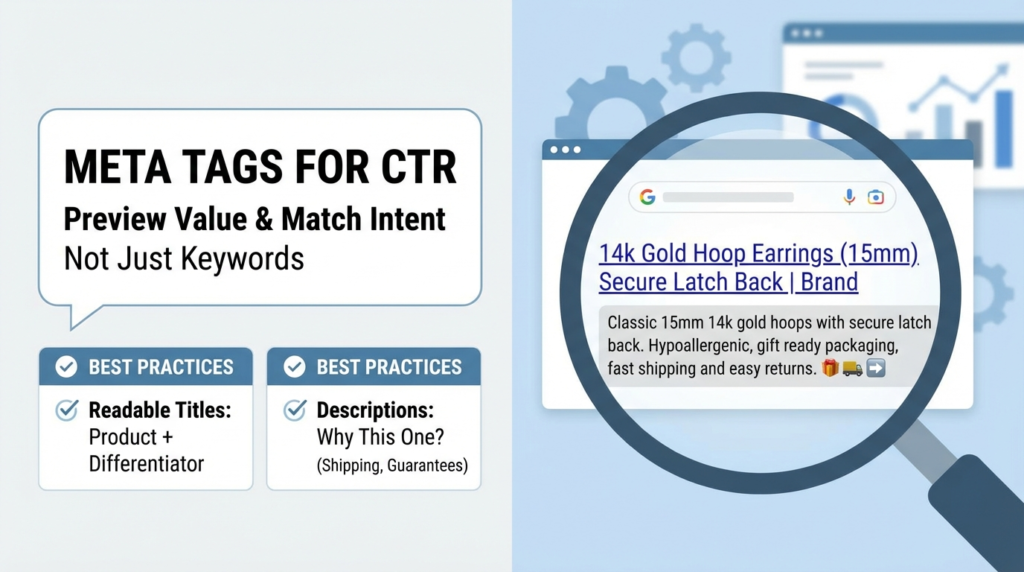
Your meta tags should preview the value and match intent, not just repeat keywords.
Best practices:
- Keep titles readable, lead with the product, then the differentiator
- Use descriptions to answer “Why this one?” (shipping, materials, guarantees)
Jewelry example (copyable):
- Meta title: 14k Gold Hoop Earrings (15mm) Secure Latch Back | Brand
- Meta description: Classic 15mm 14k gold hoops with secure latch back. Hypoallergenic, gift ready packaging, fast shipping and easy returns.
How to implement: How to add meta tags to Shopify product pages
How should I use H1, product titles, and long tail keywords?
Use one clear H1 that matches the product name, and support it with specific attributes shoppers search.
Keyword placement strategy:
- H1: the product name people would type
- Above the fold: 1 to 2 primary attributes (material, size, gemstone, style)
- Body copy: naturally include long tail variations
Example H1: “Sterling Silver Birthstone Necklace (Garnet, January)”
Helpful links: How to do keyword research for Shopify products.
Do product descriptions matter for SEO on Shopify?
Yes. A strong description helps ranking and conversion when it adds unique information Google and shoppers cannot get from the title alone.
Balance SEO + CRO by including:
- Materials and care (like “14k solid gold vs gold plated”)
- Sizing and fit guidance (mm, chain length, clasp type)
- Use cases (gift, daily wear, sensitive skin)
- Objection handling (returns, warranty, shipping time)
AI usage properly: AI can draft, but you must add brand specific details and verify claims. Thin AI text that says nothing unique is unlikely to rank long term.Related: How to use AI for Shopify product descriptions SEO.
What technical SEO issues stop Shopify product pages from ranking?
If Google cannot reliably index the right URL, your content work will not stick.
How do I fix duplicate content and canonical tag problems?
Shopify can create multiple URLs for the same product (collections, variants), which can dilute signals if canonicals are wrong.
What to check:
- Product accessible from multiple collection paths
- Variant URLs creating near duplicate pages
- Canonical points to the preferred product URL
Google’s canonical guidance: (Source: Google Search Central, 2024)
Fix help: How to fix duplicate content on Shopify product pages
What URL structure is best for Shopify product pages?
Short, readable URLs are best, but stability matters more than perfection.
Do:
- Keep handles clean: /products/14k-gold-hoop-earrings-15mm
- Avoid frequent URL changes that cause redirect chains
Be cautious with removing /products/ because it often requires complex rewrites and can introduce crawling issues.
More: How to optimise Shopify product URLs.
Why is my product page not showing on Google?
Usually it is indexing controls, duplication, or errors.
Quick checks:
- Is the page set to active and available to the sales channel?
- Is it blocked by noindex or robots?
- Does Search Console show “Duplicate, Google chose different canonical”?
- Are there 404s from old product handles?
Support: Why is my Shopify product page not showing on Google.
How do I get rich snippets for Shopify products (price, availability, reviews)?
Add valid Product structured data so Google can show rich results when eligible. (Source: Google Search Central, 2024)
Minimum fields to aim for:
- name, image, description
- offers (price, currency, availability)
- aggregateRating (only if you truly have reviews)
Implementing: How to add schema markup to Shopify product page.
Should I add FAQs to product pages?
Yes, when they answer pre purchase objections. FAQs can improve on page clarity and sometimes enhance SERP presentation.
Add 3 to 6 questions like “Is this solid gold or plated?” and “What is the return policy?”
More: How to add FAQ to Shopify product pages for SEO.
How do I optimize Shopify product images for SEO without slowing the site?
Use fast, descriptive images that still look premium on mobile.
Best practices:
- Compress images and serve modern formats where possible (Source: Google Search Central, 2023)
- File names: 14k-gold-hoop-earrings-15mm-front.jpg
- Alt text: describe what is in the image, not a keyword list
Example alt text: “Close up of 14k gold 15mm hoop earring with latch back clasp.”
More: How to optimise product images for Shopify SEO.
What UX changes improve both rankings and conversion rate?
Better UX lifts SEO indirectly by improving CTR, reducing friction, and increasing satisfaction.
High impact CRO elements for jewelry product pages:
- Clear sizing and fit section (mm, model photo notes)
- Trust signals: reviews, materials authenticity, care instructions
- Shipping, returns, and warranty near the buy box
- Strong CTA with stock clarity
Mobile matters because Google uses mobile first indexing and evaluates experience signals like Core Web Vitals (Source: Google Search Central, 2024).
Tools: heatmaps and session recordings to find drop offs. (Source: Google, Lighthouse documentation, 2024)
How should I structure internal links for Shopify product SEO?
Use collections as hubs and products as endpoints, then reinforce with breadcrumbs and contextual links.
Do:
- Link from the best matching collection to top products
- Add breadcrumbs so Google understands hierarchy
- Link from blog posts to relevant product pages (gift guides, care guides)
Helpful: How to use breadcrumbs in Shopify for SEO.
How do I handle variants, out of stock, and seasonal products without losing SEO?
Keep the page live when demand will return, and avoid fragmenting similar items across duplicate pages.
Practical guidance:
- Variants: keep one canonical product page where possible and make variant selection clear
- Out of stock: keep URL, offer “notify me,” suggest close alternatives
- Seasonal: keep evergreen URLs and update content for the season
Examples:
- If “Garnet birthstone necklace” is out of stock for 2 weeks, keep it live and add restock ETA.
- If you sell “gold hoops 10mm, 15mm, 20mm,” use one product with size variants unless photography and intent truly differ.
- For “Mother’s Day jewelry gifts,” reuse the same collection URL each year and refresh copy and internal links.
Shopify product page SEO checklist (rank and convert)
Use this as your implementation order.
- Confirm indexability in Search Console and fix 404s
- Choose a primary keyword + 3 to 6 long tail terms per product
- Write a human first title (H1) + unique description with specs and objections
- Improve meta title and description for CTR
- Add Product schema and validate in Rich Results Test
- Optimize images (size, filename, alt text)
- Add trust elements (reviews, shipping, returns, sizing)
- Strengthen internal links from collections, breadcrumbs, and blog content
- Review duplication and canonicals for variants and collection URLs
- Track performance and iterate monthly
Key takeaway: Ranking and conversion are the same project on product pages.
Best for / Not for
Best for:
- Stores with clear product differentiation (materials, sizing, authenticity)
- Catalogs where collections can pass authority to best sellers
- Merchants willing to improve content and technical fundamentals
Not for:
- Copying manufacturer descriptions across dozens of listings
- Relying on “hidden keywords” or keyword stuffing
- Aggressively changing URLs without a redirect plan
FAQ
How long does Shopify product page SEO take to work?
If pages are indexable and improvements are meaningful, you can see movement in weeks, but stable results often take longer. Technical fixes can help quickly, while authority and content usually compound over months.
Should I noindex tag pages or internal search pages?
In most cases, yes, because they tend to create thin or duplicate URLs that waste crawl budget. Always confirm your theme and apps are not generating indexable duplicates you did not intend.
Can I rank product pages without a blog?
Yes, but a blog helps you earn links, target informational queries, and funnel internal links to product pages. For jewelry, guides like “necklace length chart” or “14k vs 18k gold” naturally support product SEO.
Do reviews help SEO?
Reviews help conversion directly and can support rich results if marked up correctly and policy compliant. Only mark up reviews you actually display and collect legitimately. (Source: Google Search Central, 2024)